
Carillon House is in Play


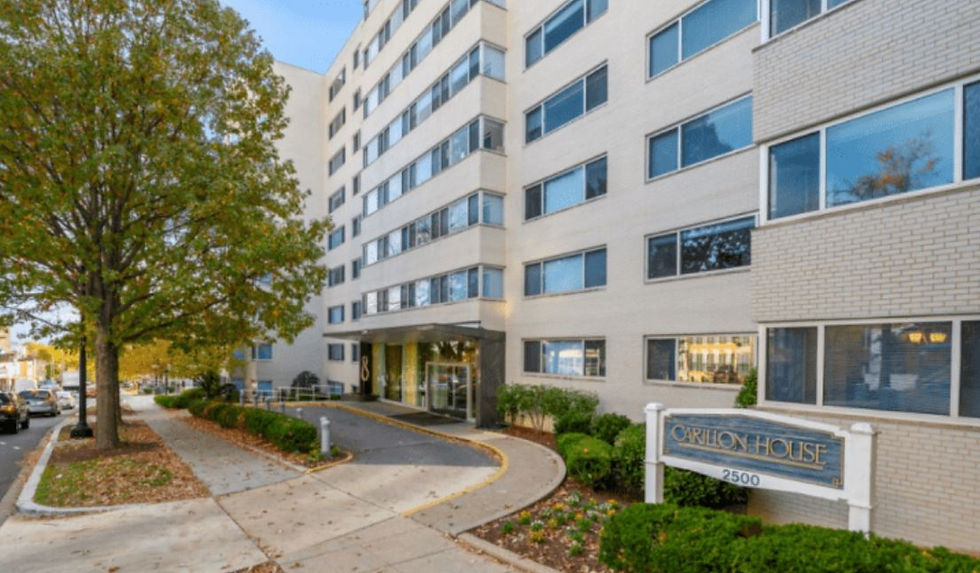
The phone call came in – no greeting, just five words: “Blue horseshoe loves Carillon House,” *click*. I asked the staff to check the arbs – yes, Carillon House is in play. This is not a hot stock tip, but it is a hot commodity. Carillon House is the massive apartment building in Glover Park at 2500 Wisconsin Avenue NW at the corner of Calvert Street, and the owner just filed for a potential sale.
In DC, “filing” for a potential multifamily residential property sale does not mean listing or advertising it. In fact, the property is not advertised for sale. Owners considering a sale must file their intentions with the DC Department of Housing and Community Development (DHCD) under the Tenant Opportunity to Purchase Act (TOPA). On July 7th, the owner of the 486 unit building, Gerald Taylor of Annapolis (through the Carillon House LP corporate structure), filed with DHCD a Notice of Sale WITH a third party contract to purchase. The other option is a notice of intention to sell without a contract, but in this case there is a buyer already. Not so fast – DC does not allow the sale of an apartment building without the blessing of the tenants – they have TOPA rights. These rights are complex, but boil down to the right of the tenants to buy the building at the same price within a certain timeframe, or sell their rights to anyone they wish. The tenants appropriately organized a tenant association, hired a lawyer and asserted their interest in the property with a Letter of Interest filed with DHCD on August 20th.

Cue the TOPA sharks. TOPA was enacted 46 years ago to address the concerns about tenant displacement during the condo craze of the late 70’s*. The intention was to give them the power to remain in place by organizing the building’s tenants to purchase the property through a kind of tenant collective, called a Limited Equity Cooperative. In the mid-1990’s the rights expanded to include the right to sell their right to purchase, as the instances of organizing an entire building of renters to purchase it proved to be few and far between, though it did occur in some cases. Financing such an endeavor was (and is) quite difficult as private lenders shied away from giving loans considering the risks of TOPA rights. The intention of this “right to assign”, for practical purposes, was to give tenants bargaining power to negotiate a cash payout to move or building improvements to stay. In fact, according to the DC Policy Center (DCPC), “95 percent of sales where a tenant association forms result in an assignment of purchase rights,” meaning they typically sell the rights to the existing buyer, or another buyer who usurps the current buyer, for some sort of compensation.
While the intentions might have been noble, and DC does of course have a very strong tenant lobby considering close to 60% of residents are renters, unintended consequences emerged. Savvy lawyers, often in partnership with opportunistic investors, saw the opportunity to seek to purchase these TOPA rights from tenants, often without the intention of buying the property, but simply to extract a cash payment from the legitimate buyer by holding the property for ransom. TOPA rules are quite complex, and come with a string of time periods, such as notices, financing applications, re-negotiations, inspections etc… As a result, people recognized that a sale could be held up for a year or more by using every time period to the fullest extent, and then if every “t” was not crossed and every “I” not dotted, they could start all over again and hold it up indefinitely. These people became known as the TOPA Sharks, and they would smell blood in the water when they saw the DHCD Notice of Sale (which is public record). Single family properties (houses, condos and coop units) also fell under TOPA, not just apartment buildings. These were prime targets because often the seller could not afford a lawyer and they needed to sell their house on schedule so they could move somewhere else. Single unit housing was exempted about 8 years ago due to the concerns that most of the time people were simply trying to extract a payoff. The DCPC stated that “the DC Council found that applying TOPA to single-family homes did not effectively achieve its original goals of expanding homeownership for lower-income tenants, preserving affordable rental housing, or preventing displacement,” and that “TOPA was never intended to serve as a tool for wealth transfer to tenants or to unfairly interfere with private home sales.”
Large buildings are less susceptible to TOPA sharks because tenants are required to form a tenant association, and usually hire a knowledgeable lawyer to represent them in guiding them through the process. In addition sellers of such properties generally have the means to wait if necessary, and typically expect a delay. Once over 50% of tenants have joined the association and pledged their rights to it, anyone seeking to purchase the rights must deal with the association through their lawyer. This empowers the tenants to seek a promise of building improvements from the new buyer through negotiation during the TOPA period, or simply to get a pledge of a cash payout for each tenant at closing, often used when the new buyer wishes to evict everyone and convert the property to condos.

Tenant organization to purchase a building such as Carillon House is very rare in NW DC. In fact, it is estimated that there are only about two dozen apartment buildings in the entire city built before 1978 with over 400 units and the vast majority (about 9 out of 10) of all TOPA organizing occurs on the eastern side of the city. The Carillon House Tenant Association has not stated its intentions publicly, though it is likely they have been advised to negotiate carefully, as too many demands from a new buyer can sour a deal, especially in a building subject to rent control. Interestingly, DCPC estimates that only 21% of the city’s 138,000 rental units are rented at market rate (not subject to rent control, or subsidized or provided by the city).

Carillon House was constructed in 1950 by Waverly Taylor, who died in 1986 and left the property to his son Gerald, the current owner. The DC Architects Directory noted that Gerald believed Carillon House was the first apartment building in DC built with central air conditioning. The sleek nine-story building has 486 studio and one-bedroom units with full-service amenities, including a roof deck with amazing city views. Those living on the north side get to spy on the Russians (yes it was a concern in the 1960’s when the embassy was built) and those on the south side get great July 4th and year round river views down the hill to Georgetown. Management was taken over by ROSS Companies in 2020 and most units have been renovated, as apartment turnover takes place. While most renters would not call it “affordable” housing, for western NW DC it’s not bad - you can get a studio for $1600-$1900 and a 1BR for $2000-$2400 with all utilities included. Currently, only 13 units are available – want to get in on the TOPA payout? I’m not sure that’s the way it works, consult a lawyer…
Gerald Taylor refinanced $33 million in mortgages with United Bank two weeks ago and the property currently has a tax-assessed value of $78 million. The reason for the refi is not clear, though it could be the loans were due, or he expects this to be a drawn out sale process and wants to prepare now. See bio for Waverly Taylor attached below.
*TOPA stats and facts from The DC Policy Center's publication, "TOPA’s Promise and Pitfalls: Balancing tenant rights, affordability, and housing investment in Washington, D.C." March 13th, 2025.


Comments